

UAE Free Zone Audit Checklist: Key Documents and Steps Businesses Should Prepare
Many companies set up operations in the UAE Free Zones because they can operate their businesses under simple rules, gain access to global markets, and benefit from tax exemptions.
Businesses need to fulfil the financial reporting obligations required by their Free Zone authorities, despite the advantages they receive from their location. One of the general obligations is the requirement to prepare audited financial statements.
The Free Zone authorities usually require businesses to maintain proper accounting records, which must be provided upon request, typically during licence renewal. Additionally, businesses might need to present financial information during regulatory reviews, shareholder meetings, or financial assessment meetings.
Companies that prepare their audited financial statements are likely to operate more quickly and comply more successfully with all rules.
Companies can organise their financial records, verify their accounting documents, and prepare the required audit materials using the UAE Free Zone audit checklist.
UAE Free Zone Audit Checklist for Businesses
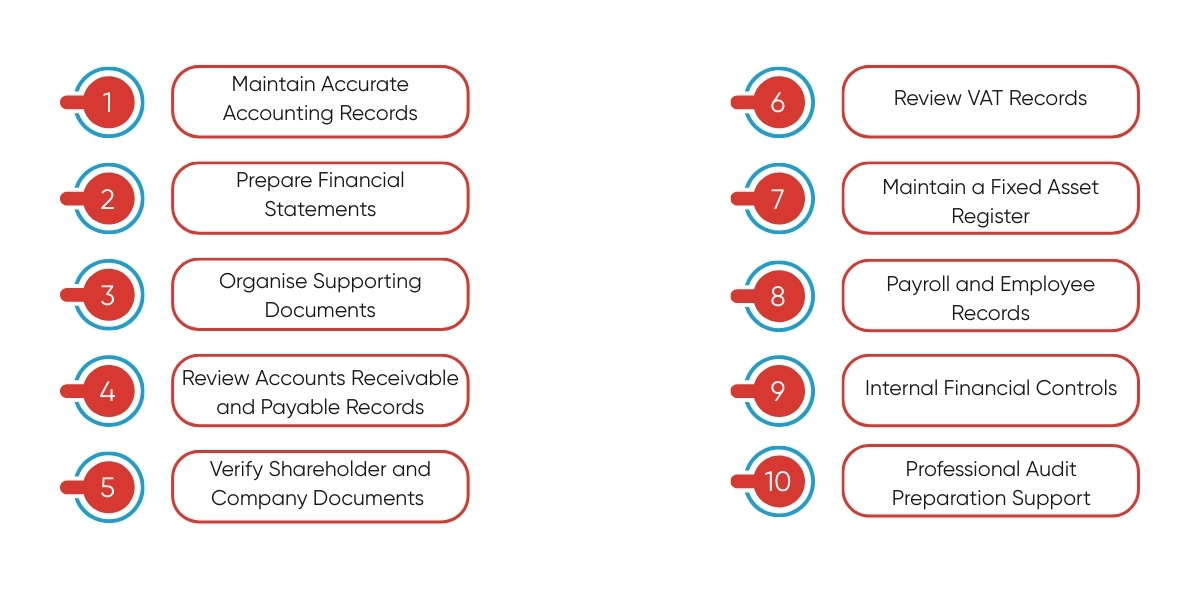
Preparing financial documentation before a UAE free zone audit reduces delays and helps auditors complete their review efficiently. A structured UAE Free Zone Audit Checklist will enable businesses to ensure that key records/documents are available for examination.
A Free Zone audit helps preserve financial reporting transparency, even though many businesses view it largely as a statutory duty. Accurate accounting records allow businesses to present reliable financial information to regulators, investors, and management.
In several UAE Free Zones, audited financial statements may also be required for licence renewal or regulatory submissions, making proper preparation essential.
Maintain Accurate Accounting Records
Accurate bookkeeping is the starting point for the entire audit process. All financial transactions must be accurately entered into the accounting records. This will ensure that the accounting records are updated regularly.
The accounting records should reflect revenue, expenditure, and other financial changes that occurred in the financial year. In addition, it is vital to reconcile the accounting records with the bank statements to ensure there are no discrepancies.
Prepare Financial Statements
The auditors will use the financial records to prepare their report regarding the company’s financial position. The company must prepare the balance sheet, profit and loss statement, and cash flow statement for the relevant financial year.
These statements summarise financial performance, assets, liabilities, and operational results. Supporting notes may also explain accounting policies, significant financial movements, and adjustments made during the reporting period.
Well-prepared financial statements allow auditors to assess the company’s financial condition more efficiently.
Organise Supporting Documents
Supporting documents are necessary to verify transactions recorded in the accounting system. Businesses need to keep their sales invoices, purchase invoices, payment receipts, supplier statements, and customer transactions in proper order as part of their record management process.
The organisation must keep both its bank statements and bank reconciliation reports accessible for review. The documents enable auditors to verify that financial records match the actual banking transactions.
Companies that maintain their documents throughout the year will experience fewer disruptions during their audit.
Review Accounts Receivable and Payable Records
Businesses need to review their accounts receivable and accounts payable before the audit begins. This is because accounts should be recorded correctly and payments reconciled with the relevant documents.
Auditors may check whether the accounts receivable reflect the actual customer receivable balances and whether the accounts payable recorded in the books represent the actual supplier payable balances. Keeping accounts receivable and accounts payable records accurate will help auditors verify the financial statements and ensure proper reporting of financial obligations.
Verify Shareholder and Company Documents
Auditors can use the company’s Memorandum and Articles of Association to examine the corporate structure.
Companies should ensure their trade licences, share certificates, and incorporation documents are up to date and readily available.
The Memorandum and Articles of Association may also be examined during the audit. The document serves to establish proof of the company’s ownership structure.
Review VAT Records
A company operating in the UAE is required to maintain complete tax documentation in compliance with VAT laws. The tax records include VAT returns, tax invoices, and records used to compute input/output tax.
Maintaining VAT records helps ensure accurate tax reporting and that the company’s financial records comply with tax requirements.
Maintain a Fixed Asset Register
Companies are required to maintain records of their assets, including significant assets. The record includes descriptions of the assets, the purchase date, the amount spent to acquire the assets, and the amount depreciated.
The organisation is required to provide purchase invoices for all assets purchased, which serve as evidence of their purchase.
Payroll and Employee Records
The employee-related financial records may also be subject to audit. Businesses should maintain payroll records, salary records, and employee contracts.
The payroll records may be subject to audit, and, if necessary, the audit may confirm whether the salary expenses recorded in the books of accounts are accurate.
Internal Financial Controls
The auditor may also subject the company’s internal financial procedures to audit. Companies need to establish effective financial control systems to reduce accounting errors while ensuring compliance with proper accounting standards. The auditors use the documented procedures to trace the process of financial transaction approval and documentation.
Professional Audit Preparation Support
Many companies also seek assistance from audit firms in Dubai or specialised audit firms in the Free Zone area when preparing for a UAE Free Zone audit. Expert auditors may review accounting records, identify any missing paperwork, and ensure the financial statements comply with Free Zone reporting regulations.
Before starting the primary audit, several auditing firms conduct preliminary financial audits. This is beneficial to businesses, as it enables them to address inconsistencies and prepare documentation in advance, thereby facilitating the audit process.
Maintaining Financial Records for a Smooth Audit Process
Businesses establish an organised audit system through proper financial recordkeeping. Maintaining proper documentation, bookkeeping, and financial reporting can help businesses avoid delays during the review process.
UAE Free Zone businesses can take advantage of audit support services. Premier Auditing & Accounting LLC provides audit support service that helps businesses prepare their financial statements and ensure proper financial reporting.

 Previous


